
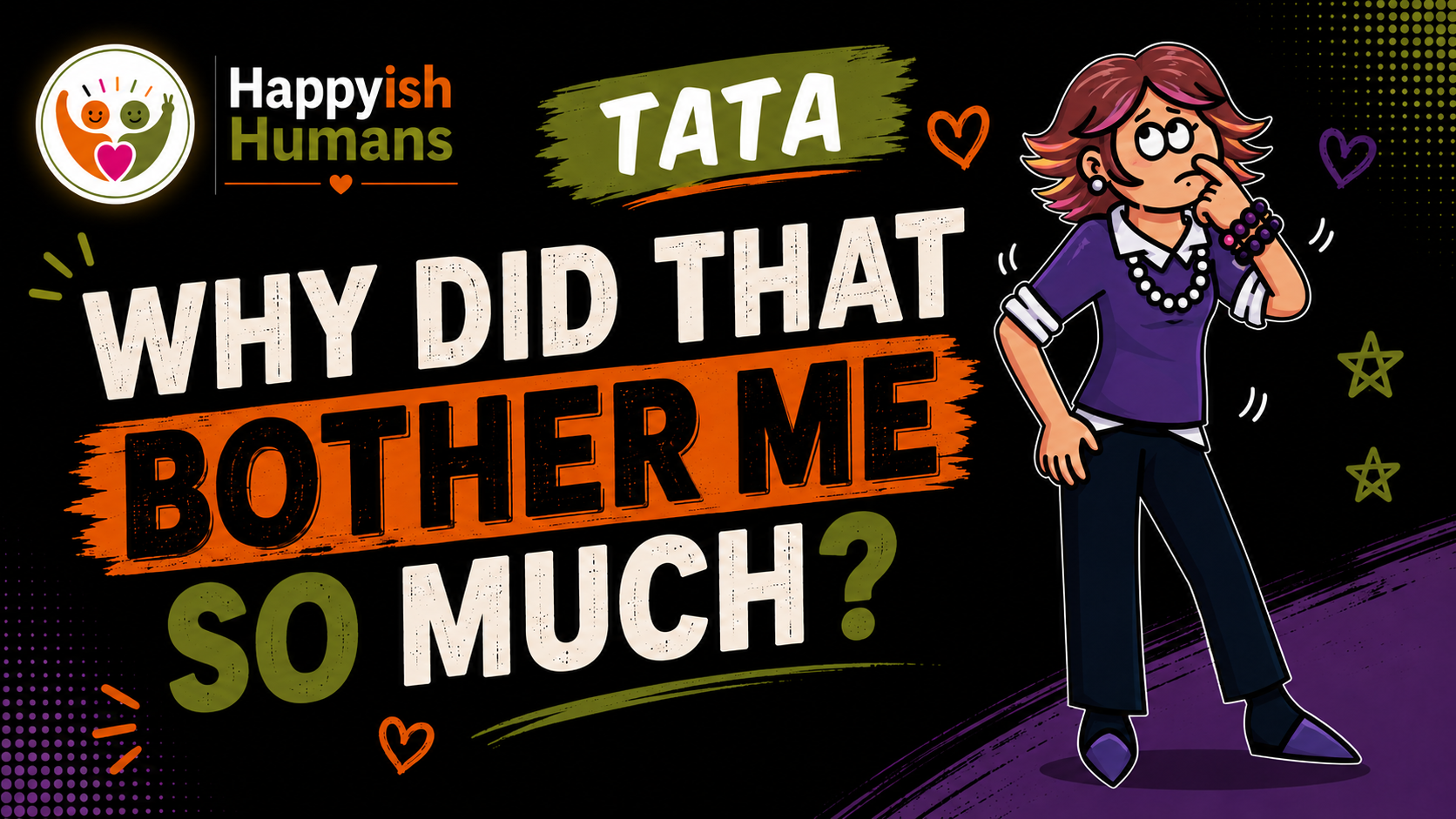
Today's question is "Why did that bother me so much?", sponsored by TATA, your Adaptation Voice, the part of you that doesn't just notice things, she decides what they mean.
It shows up after the meeting where your boss said nine nice things and one "I'm not so sure about that," and somehow that one line doesn't just stick, it turns into "they think I'm not good at this." It shows up when a friend doesn't text back for three hours and that silence doesn't just sit there, it becomes "did I say something wrong and that's why they haven't texted?" It shows up when someone's tone is slightly off and within four seconds you've decided that their "tone" is all about you.
You think this means you're too sensitive, or dramatic, or "reading into things," but you're not. It just means that TATA already assigned a meaning to what happened, and she assigned the worst one available.
THE SCIENCE PART
Here's what's actually happening, and it's not a personality flaw, it's a setting your brain came with.
TATA's whole job is meaning-making. Something happens, and she doesn't let it just sit there as a neutral fact; she tells you what it means. That's her function. The problem is the meaning she reaches for first is almost never the neutral one.
That's because of negativity bias, your brain's built-in habit of treating bad information as more important, more urgent, and more true than good information, even when they're sitting right next to each other. So, when TATA goes looking for what a moment means, she's not pulling from a fair deck. The negative interpretation gets dealt to the top of the pile every time, because your brain is wired to think the negative meaning is the one that's more likely to keep you safe.
Think of it like a translator with a bias. Someone says "I'm not so sure about that," which is what was actually said, but TATA takes it to the translator, and the translator hands back "your boss is not happy with the work you're doing." This is not an accurate translation, of course, but the negativity bias translator always tends to assume that the worst-case meaning is the real one. Nine compliments get translated as small talk. One piece of feedback gets translated as a verdict. Same room, same conversation, wildly different translation, because the negativity bias is the one holding the dictionary.
That one comment didn't bother you because it was true. It bothered you because of the story TATA created about what it means.
THE CHILDHOOD PART
Kids don't come out of the womb assuming the worst-case meaning. That gets built, and it usually gets built in rooms where guessing the meaning correctly actually mattered.
Maybe you grew up somewhere the mood could shift fast, so you learned to read the meaning behind things quickly, because knowing what a silence, a sigh, or a certain tone actually meant could tell you what was coming next. Maybe one B on a report card full of A's didn't just get noted, it got a whole conversation, so you learned that the meaning of "one imperfect thing" was "you need to explain yourself." Maybe you were the one who had to figure out what your parent's mood meant for the rest of the evening, so you got fast, and good, at deciding what things meant, quickly, usually assuming the worst so you'd be prepared for it.
None of that was you being dramatic. That was a smart kid learning that meanings matter, and that the safest move was to assume the meaning was bad, because being braced for a bad meaning felt safer than being caught off guard by one.
The problem is that skill didn't come with an expiration date. It just kept assigning meanings, long after you left the room it was built in. So now you're in a completely reasonable meeting with a completely reasonable boss, and TATA is still doing the same job she was trained to do: hand you the worst-case meaning first, fast, before you've even had a chance to ask if it's actually the right one.
That's not oversensitivity. That's an old meaning-making habit still clocking in for a job that ended a long time ago.
THE GO-TO OPTIONS
So, when something small bothers, you usually do one of two things.
Option one: you accept TATA's meaning as fact. "They said they're not sure about that" quietly becomes "they think I'm bad at my job," and you never actually stop to check if that's the meaning, or just a meaning. This feels like insight. It's actually just the negativity bias wearing a very convincing outfit.
Option two: you tell yourself the meaning shouldn't bother you, and shove it down. "It's fine, it doesn't mean anything, I'm being weird." Except you haven't actually questioned the meaning, you've just muted it, so it sits there unresolved, waiting for the next ambiguous comment to reattach itself to.
Neither one checks whether the meaning was even accurate. One accepts the translation. The other just stops listening to it out loud.
THE HAPPYISH HUMANS SHIFT
There's a third option, and it starts with putting TATA's translation on trial before you accept it as fact.
Name who's talking and what it is that you're feeling. "This is TATA. She's already decided what this means." That's the voice. Now name the feeling she's reacting to, underneath the story: rejected, dismissed, small, not taken seriously. TATA moves fast from feeling to meaning, so if you skip straight to arguing with her story, you're still one step behind. Naming the actual feeling first, out loud or on paper, measurably quiets the brain's alarm system; it's called affect labeling, but really it's just name it to tame it. So, the full move is: "This is TATA, and what I'm actually feeling is ___." Once the feeling has a name, the story underneath it gets a lot easier to question.
Reframe the question. Swap "Why did that bother me so much?" for:
"What meaning did TATA assign here, and is it the only one?"
"Am I reacting to what happened, or to the story I built on top of it?"
"What would I think this meant if it happened to someone else?"
"Why did that bother me so much" keeps you circling the reaction. These questions actually get you to the meaning underneath it, which is where the real work is.
Check the evidence. Separate the event from the meaning, literally, if you have to:
Event: "They said they're not sure about that."
Meaning TATA assigned: "They think I'm bad at my job, they regret hiring me."
Said out loud, the gap between the two usually looks huge, because it is. The event is one sentence. The meaning is a whole story TATA wrote on top of it. Then ask where the meaning actually came from: "Did they say that, or did I fill in the meaning myself?" Most of the time, the meaning didn't come from the other person at all, it came from TATA's negativity bias reaching for the worst-case option out of everything it could have meant. And look for other possible meanings, because there are always at least three. Maybe it meant nothing, they were just giving normal feedback. Maybe it meant they trust you enough to be direct. Maybe it meant literally nothing about you at all, and everything about their own deadline that day. Negativity bias only ever offers you one option. Make yourself find two more.
Find the silver lining, use positive words or affirmations, or reframe the story. Not toxic positivity, just a wider lens. "This meaning felt true, but it was one option out of several." Or: "I've been wrong about what things meant before, and I survived that too." You're not lying to yourself. You're just refusing to only look at the worst-case version of the story.
Pick some tiny actions.
Write the event and the assigned meaning on separate lines, so you can see the gap.
Ask yourself what meaning you'd assign if a friend told you this exact story about themselves.
Set a timer for five minutes to sit with the meaning, and when it goes off, you're done deciding for today.
Do one thing unrelated to the situation, fold laundry, walk around the block, anything that isn't rereading the email for hidden meaning.
Say it out loud: "That's one possible meaning. It's not the only one."
WHY THE SMALL STUFF WORKS
TATA runs on unchecked meanings, so the fastest way to quiet her down is to actually check the meaning instead of accepting the first one she hands you. Once you separate the event from the story TATA built on top of it, there's nothing left holding the worst-case interpretation together. Negativity bias needs you to skip that step to work. Slow down enough to ask "is that really what this means," and the whole thing loses steam.
You don't need a life philosophy to make this work. You need five minutes, a pen, and the willingness to admit the first meaning your brain hands you probably isn't the only one available.
FINAL NOTE
Nothing is wrong with you for being bothered by something small. Your brain is doing exactly what it was built to do: reach for the worst-case meaning first, and hand it to you before you've had a chance to check it. You're not too sensitive. You're just accepting a translation from a translator who's had a grudge against good news since childhood.
You got this! Nobody is coming to save you… you have to save yourself!
INSPIRATION: "Your worst enemies won't harm you as much your own unguarded thoughts." -Buddha