
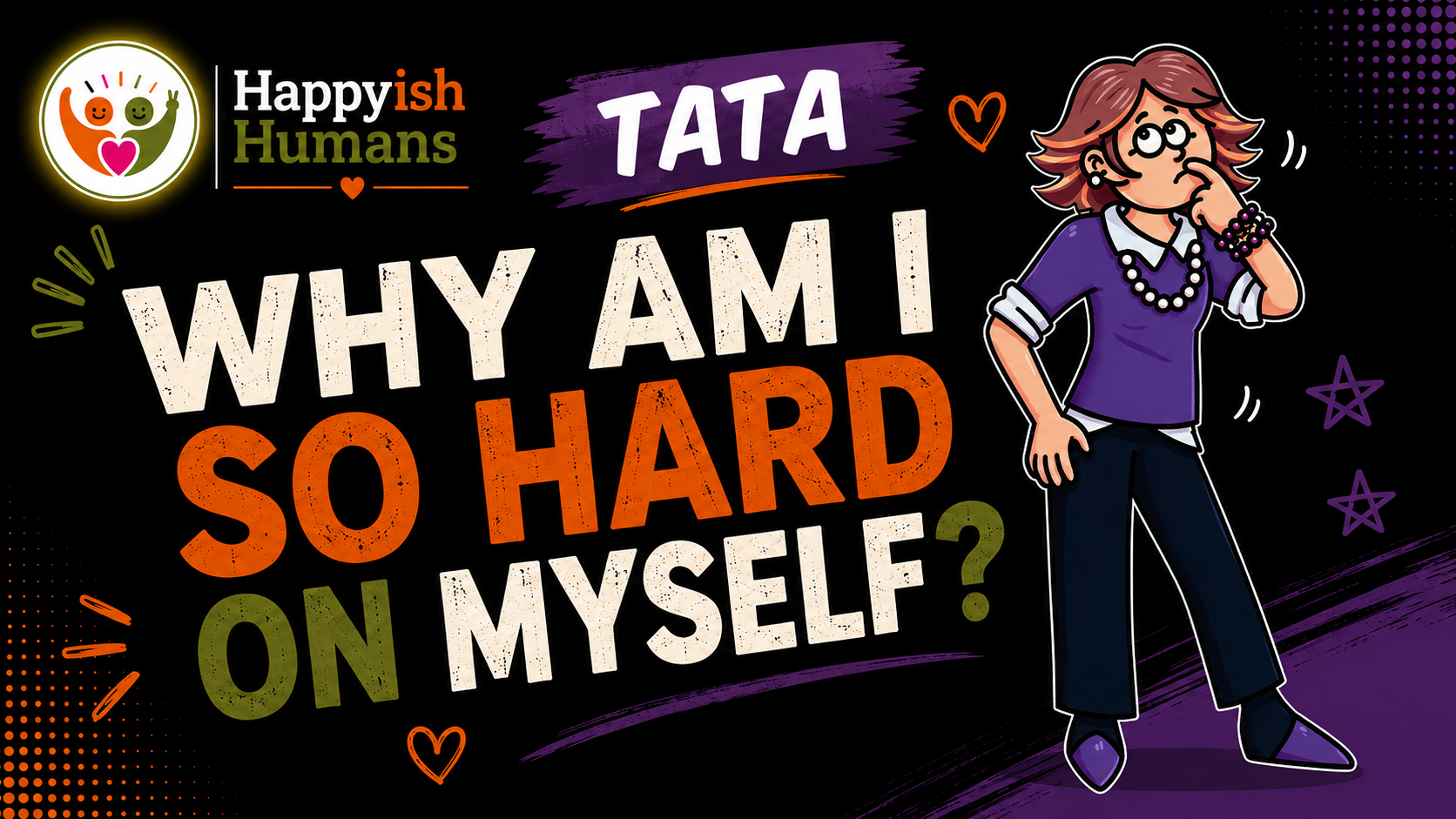
Today's question is "Why am I so hard on myself?", sponsored by TATA, your Adaptation Voice, the part of you that figured out a long time ago that blending in perfectly was the price of admission.
It shows up when you walk into a room and immediately scan for what everyone else is wearing, saying, laughing at, before you've said a single word yourself. It shows up when you give a good answer in a meeting and instead of letting it land, you replay it, wondering if it sounded "too much" or "not enough," too eager or too quiet, too different from how everyone else answers. It shows up when you edit a text three times before sending it, not because the message is wrong, but because you're not sure it sounds like something a person "like you're supposed to be" would say.
You think this means you're just conscientious, or that you care about doing things right. Maybe. But mostly it means TATA decided somewhere along the way that fitting in wasn't optional; it was survival, and being flawless was the only way to guarantee nobody noticed you as the odd one out.
THE SCIENCE PART
Here's what's actually happening, and it's not vanity, it's wiring.
Humans have a hardwired need to belong; researchers call it the belongingness hypothesis, and the short version is this: your brain treats social exclusion almost like a physical threat, because for most of human history, being cast out of the group meant you didn't survive on your own. TATA took that ancient wiring and built a strategy on top of it: if you can't control whether people like you, you can at least control how seamlessly you fit the mold, and if you fit it perfectly enough, nobody has a reason to push you out.
Here's the catch, though: fitting in and belonging are not the same thing. Fitting in is editing yourself down until you match everyone else. Belonging is being fully yourself and still being wanted in the room. TATA's been chasing the first one, convinced it would eventually turn into the second. It doesn't; it just keeps you exhausted, one self-edit at a time.
THE CHILDHOOD PART
Nobody's born auditing themselves for how well they blend in. That gets built, usually somewhere that being different, in any direction, came with a cost.
Maybe you grew up in a family, a school, or a culture where standing out wasn't celebrated, it was risky; the kid with the different accent, the different interests, the different house, the different way of feeling things, got noticed for the wrong reasons. Maybe you learned early that sameness kept you safe, and difference invited teasing, exclusion, or a kind of attention you didn't want. Maybe being "extra" in any way, too loud, too sensitive, too smart, too anything, meant getting left out of something that mattered to you.
None of that was you being insecure. That was a smart kid noticing the actual social rules of the room and adapting to them, because belonging felt like it depended on not giving anyone a reason to single you out. The problem is that strategy never came with an expiration date. It just kept running, long after the room changed, long after most of the people around you stopped keeping score.
THE GO-TO OPTIONS
So, when TATA starts auditing how well you're blending in, you usually do one of two things.
Option one: you smooth yourself out completely; match the tone, the opinions, the pace of whoever's around you, and call it flexibility. This feels like fitting in successfully. It's actually just perfectionism wearing a different outfit, still convinced that the safest version of you is the one nobody can pick out of a crowd.
Option two: you swing the other way and insist loudly that you don't care what anyone thinks, that fitting in is beneath you, without ever actually questioning why the fear of standing out is so loud in the first place. This can look like confidence. It usually isn't; it's TATA still running the same program, just performing the opposite of fitting in instead of doing the work of belonging.
Neither option questions whether blending in was ever the thing that made you safe to begin with. One edits you down. The other just edits you louder.
THE HAPPYISH HUMANS SHIFT
There's a third option, and it starts with questioning whether fitting in was ever actually the same thing as belonging.
Name who's talking and what it is that you're feeling. "This is TATA. She thinks blending in perfectly is the only way I get to stay in the room." Then name the actual feeling underneath the self-editing, not the thought, the feeling: exposed, different, afraid of being singled out. Naming the feeling itself, out loud or on paper, is called affect labeling; in plain terms, name it to tame it. It measurably calms the brain's alarm system, because a named feeling is easier to hold than an unnamed one circling in the background. So the full move is: "This is TATA, and what I'm actually feeling is ___." Not the verdict about how well you fit in, but the feeling underneath it.
Reframe the question. Swap "Why am I so hard on myself?" for:
"What is TATA afraid will happen if I stand out here?"
"Is this room actually asking me to blend in, or is that an old rule I'm still following?"
"What would it look like to belong here as myself, instead of a smoothed-out version of myself?"
"Why am I so hard on myself" keeps you stuck explaining the self-editing. These questions get you underneath it, to what TATA's actually protecting you from.
Check the evidence. Separate the actual moment from the meaning TATA assigned to it:
Event: "I said something in the group chat that didn't match everyone else's energy."
Meaning TATA assigned: "This proves I don't fit here, and now everyone's noticed."
Then ask where the meaning actually came from: "Did anyone actually treat me differently, or is TATA just assuming they will?" Most of the time, the answer is that the moment was small and unremarkable to everyone but you, and the fear of being "found out" as different was entirely TATA's invention. Look, too, for what blending in actually got you here: did it make people want you around, or did it just make you disappear a little, so they never really got the chance?
Find the silver lining, use positive words or affirmations, or reframe the story. Not toxic positivity, just a wider lens. "The people worth belonging with were never asking me to disappear." Or: "Fitting in got me a seat at the table; being myself is what actually keeps me there." You're not throwing out every instinct to adapt. You're just refusing to let sameness be the whole price of belonging.
Pick some tiny actions.
Say one honest opinion out loud today, even a small one, without softening it first.
Wear, say, or do the thing you'd normally edit out "to be safe," and notice what actually happens.
Ask yourself who in your life has never needed you to blend in, and spend a little more time there.
Catch yourself mid-edit and ask, "Am I changing this to be clearer, or to be less noticeable?"
Say it out loud: "I don't have to disappear to belong."
WHY THE SMALL STUFF WORKS
TATA runs on the belief that sameness equals safety, so the fastest way to loosen her grip is proof that it doesn't hold up, small, repeatable proof, not a grand gesture. Every time you let a little bit of the real you show and nobody pushes you out for it, TATA collects a little evidence that blending in was never actually the requirement. She doesn't drop a belief because you argued her out of it. She drops it because reality kept quietly disagreeing with her.
You don't need a dramatic reinvention to loosen this. You need a handful of small moments where being noticeable didn't cost you the room, and the willingness to actually notice when it doesn't.
Please remember this, even if you don't understand it yet:
Trauma teaches that different is dangerous. Adaptation maintains it by keeping you blended in.
LOLA is the root. TATA is the mechanism. UNGA fuels the urgency. AKO is the way out.
FINAL NOTE
Nothing is wrong with you for wanting to fit in; wanting to belong is about as human as it gets. Your brain just decided somewhere along the way that being flawless and forgettable was the safest way to keep your seat at the table, and TATA's been clocking in for that job ever since, even now, in rooms that were never actually asking you to disappear. You're not hard on yourself because you're broken. You're hard on yourself because blending in once felt like the only way to be allowed to stay.
You got this! Nobody is coming to save you… you have to save yourself!
INSPIRATION:
"Belonging so fully to yourself that you are willing to stand alone is a wilderness — an untamed, unpredictable place of solitude and searching." —Brené Brown, Braving the Wilderness